There's a scene in the documentary "Jiro Dreams of Sushi" where the sushi master explains why it takes ten years before his apprentices are allowed to cook the rice. Not make sushi. Just cook the rice.
The apprentices spend a decade learning to source fish, sharpen knives, maintain proper temperatures, understand seasonal variations, and build relationships with suppliers. The actual technique of cooking rice might take a few months to learn. The judgment of when you're ready to do it takes ten years to earn.
Most of the apprentices quit. They go work at conveyor belt sushi restaurants where the rice comes pre-cooked from a machine and the fish comes pre-sliced from a distributor. They can start "making sushi" on day one. It looks like sushi. It technically is sushi. It's just not the same thing at all.
From 2020 to 2023, most of us were running conveyor belt sushi restaurants and calling ourselves craftspeople.
We had systems for cranking out blog posts. We had templates for structure. We had tools for research. We had agencies we could outsource to. We had formulas: eight tips for this, ten best practices for that, twelve ways to improve something else. The articles looked like content marketing. They technically were content marketing. They just weren't the same thing at all.
Then ChatGPT showed up
And boy, did it reveal what we'd been doing all along. Most people were really just assembling pre-made components according to a formula anyone could learn in an afternoon.
If you read the previous article, you know commodity content is dead. AI didn't kill it. It was already dying. AI just made it obvious and sped up the funeral.
Now comes the harder question: What do you do about it?
The answer is uncomfortable. You do the work that good content always required. The work most of us were avoiding when we were pumping out "10 tips" posts and calling it strategy. The ten-year apprenticeship we skipped because we were too busy hitting publish quotas.
Let me show you exactly what that work looks like.
First, you need to see reality clearly.
I ran this audit on an old client’s blog last quarter. I was not prepared for how depressing it would be.
Out of 47 published posts from 2022 to 2025, I could honestly say that maybe eight of them contained anything ChatGPT couldn't replicate. Maybe. And I'm being generous because I wrote some of them and my ego was doing backflips trying to convince me they were special.
The exercise itself is simple but the honesty required is brutal. Open your blog. Pick your top 20 posts by traffic.
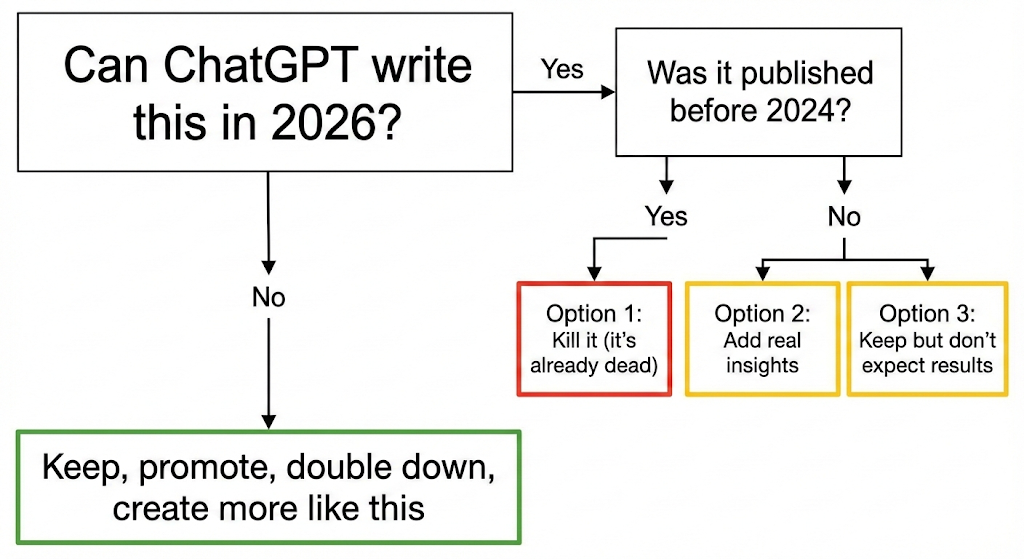
For each one, ask: "Could ChatGPT write this exact post in 2026, with these specific insights, examples, and conclusions?"
And be honest.
(This is like when your dentist asks if you've been flossing. They already know the answer. You know the answer. But you both have to go through this little ritual.)
If your honest answer is "...yeah, probably" then that post is living on borrowed time. It's the content equivalent of that milk in your fridge that technically hasn't expired yet, but you know it's going to smell weird tomorrow.
Actually, scratch that. It's 2026. That milk expired in 2024. Google's algorithm already buried it. You just haven't checked.
When you find posts that fail the test, you have three options.
Option 1: Kill it. Redirect the URL. Move on with your life.
Option 2: Make it un-AI-able. Add:
- An expert interview from 2025
- Original data from your product (2024-2025 cohorts)
- A case study from a real customer
- A contrarian take based on your experience
- A framework that connects multiple disparate ideas
- Literally anything that requires access or thinking
Option 3: Keep it but stop expecting it to do anything. It's fine to have some basic informational content. Just don't count on it for traffic or conversions. And definitely don't create more like it.
Here’s a decision tree you can use:
What makes content unkillable in 2026?
Making pieces "un-AI-able" in 2026
Add at least two of these elements:
- An expert interview from 2025-2026 with someone who lived through a specific challenge
- Original data from your product (show actual usage patterns, conversion rates, churn analysis)
- A detailed case study from a real customer (with specific numbers and timelines)
- A contrarian take based on your experience (not just "hot take" but backed by evidence)
- A framework that synthesizes multiple disparate sources (not just explaining existing frameworks)
- Longitudinal analysis (how something changed from 2023 → 2024 → 2025 → 2026)
These all require access. Access to people, data, experience, or time that AI doesn't have.
Which means the most important content asset you can build in 2026 isn't your editorial calendar or your keyword strategy. It's your network of people who will actually talk to you about what they learned the hard way. Because access to experts is the only moat that doesn't erode when the next model drops.
Building An Expert Rolodex
You probably already know 15-25 people in your space who have valuable insights:
- Other founders building adjacent products
- Customers who use your product in interesting ways
- Former colleagues from your last job
- People you met at conferences who had smart opinions
- Connections in Slack communities, Twitter, LinkedIn
- Investors, advisors, mentors who've seen the market evolve
Most of them will talk to you if you just ask. Here's a script if you need one when contacting them:
Hey [Name],
I'm writing an article about [specific topic] for [audience]. I'd love to include your perspective, specifically on [the exact thing you want to ask them about].
I noticed [specific thing they posted/achieved recently] and thought your experience would be valuable here.
Would you be open to a 20-minute call? Happy to send questions ahead of time. I'll send you the relevant section before publishing so you can approve your quotes.
No pressure if you're swamped!
This works because you're specific about what you want instead of asking to "pick your brain." You've done your homework by referencing their recent work. You're respecting their time by proposing 20 minutes, not "coffee sometime."
You're giving them control by letting them approve quotes. You're making it easy to say no. Most importantly, you're offering them a break from AI-generated nonsense and a chance to share real wisdom.
"But I don't know anyone."
Then make this your full-time job for the next 2 weeks:
- Join Slack communities in your space
- Comment thoughtfully on LinkedIn posts (not AI-generated comments—actual insights)
- Attend networking events (yes, uncomfortable, do it anyway)
- Send cold emails to people doing interesting work
"I don't know anyone" is a fixable problem. "I'm too scared to reach out" is just resistance wearing a mask.
Develop Signature Frameworks
Something AI still cannot do well in 2026……… Create genuinely new frameworks from original thinking.
It can regurgitate existing frameworks (AARRR, Jobs-to-be-Done, the 4 Ps). It's excellent at explaining them. But it can't synthesize a new framework from your lived experience, especially one that accounts for market evolution from 2022 to 2026.
What pattern have you noticed that others haven't articulated?
Think about:
Counterintuitive insights:
"Everyone says X worked in 2023, but by 2025, Y is what actually matters"
Example: "Everyone said product-led growth was the only way to scale in 2023. But companies that launched PLG in 2024-2025 found that without a strong sales-assist motion, they couldn't convert enterprise customers. The winners combined PLG for acquisition with sales-led for expansion."
Named problems:
"This common problem emerged in 2024 and doesn't have a name, so people don't realize they all have the same problem"
Example: "Post-PLG Stall: When companies hit $2M ARR through self-serve motion but can't figure out how to reach $10M because their product wasn't built for sales-assisted deals."
Process frameworks:
"Here's the 3-step system I developed between 2023-2025 to [achieve result]"
Example: "The Interview-First Content System: Interview customer before writing, extract framework from conversation, validate framework with two more customers, then write the article. This ensures every piece contains insights AI can't generate."
Evolution frameworks:
"Here's how [strategy] changed from 2022 to 2026 and what that means"
Example: "The Content Distribution Evolution: 2022 (SEO dominated), 2023 (AI content flooded search), 2024 (Google penalized AI content), 2025 (community distribution became primary), 2026 (expert platforms + owned communities are the only reliable channels)."
Once you have a named framework, you own that intellectual real estate. Every time someone searches for it or mentions it, they point back to you.
What To Do (According to Three Years of Data)
The tactical playbook isn't complicated. It's just uncomfortable because it requires patience.
- Run the AI Audit
- Open your blog
- Pick your top 20 posts from 2023-2025
- Ask honestly: "Could ChatGPT write this in 2026?"
- Make three lists: Kill, Upgrade, Keep
- Be ruthless
- Start Your Expert Rolodex
- List 15 people you could interview
- Include people who've been on similar journeys
- Reach out to 3 of them this week using the script
- Hit send (this is where most people fail)
- Develop One Framework
- What pattern have you noticed over the last 3 years?
- What do you know now that you didn't know in 2023?
- What's your contrarian take based on watching things evolve?
Write it down (even if messy) and name it something memorable.
- Write AI-Proof Content
An article that includes:
- Expert interviews
- Original insights
- Specific examples
- Your POV (even if you're not 100% sure)
- Longitudinal data if possible (how things changed over time)
- Change Your Metrics
Stop measuring:
- Pageviews
- Time on page
- Bounce rate
Start measuring:
- Qualified leads generated (content-attributed)
- Sales conversations started (track mentions of specific articles)
- Customers who reference the article (ask in onboarding)
- Backlinks from real sources (quality > quantity)
- Shares in communities where your ICP hangs out
- Distribute like crazy
You’ll thank me for this!
Good writing was always this work.
We only convinced ourselves for a decade that content marketing was different, that we could optimize our way to quality, that templates could replace thinking.
AI didn't change the rules. It just made it impossible to pretend we were following them.
Anyway, you can't optimize mastery. Jiro's apprentices spent ten years learning because there's no shortcut. The content that survived from 2023 to 2026 required access, thinking, and time that AI doesn't have.
If you're starting in 2026, you're still in a surprisingly good position. Most of your competition died in 2024 and 2025. Put in the work.