The "AI killed writing" debate is actually three separate panics in a trench coat.
[dramatically pulls open trench coat]
Panic #1: "The robots are taking our jobs!" This one's been around since the Industrial Revolution, just wearing different hats each time.
Panic #2: "Nobody knows how to write anymore!" This one's been around since Socrates complained that writing things down would ruin everyone's memory.
Panic #3: "Everything is terrible and we're all doomed!" This one's been around since, well, always.
But AI didn't kill good writing. It just made it really obvious how much of our "content marketing" was already a zombie shambling around, moaning "10 tips... must... rank... for keywords..."
The Uncomfortable Truth
Let me show you what I mean with a real experiment I ran this morning.
I found a blog post titled "15 Best Email Marketing Tips & Practices for 2026." Published by an actual marketing agency. The content opened with "Email marketing is an important channel for businesses looking to engage customers..." and offered groundbreaking insights like "Personalize your subject lines," "Segment your list," and "Test your CTAs."
So I opened ChatGPT and typed the exact same title: "15 Best email marketing tips & practices for 2026"
It took 8 seconds.
The result? Nearly identical insights. Same tired transitions like "Let's dive in!" and "At the end of the day..." Same "pro tip" callouts. Same energy of someone who has never actually sent a marketing email.
The problem isn't that AI can write this. The problem is that we were calling this content marketing.
What We Were Actually Doing (2020-2023)
Most B2B SaaS content before ChatGPT looked remarkably similar across companies. Generic "What is X?" definition posts existed purely to rank for basic queries. These were like Wikipedia but worse, answering questions with information anyone could Google in 30 seconds.
Then there were the "10 Tips for Better Y" listicles with zero original insight. Tip #1 was always "set clear goals" and tip #10 was always "keep learning." The middle eight were whatever the writer found on the first page of Google, reworded just enough to avoid plagiarism flags.
Tool comparison posts followed a simple formula: scrape G2 reviews that were probably fake anyway, create feature tables copied from pricing pages, and publish. No actual product testing. No real user interviews. Just data aggregation pretending to be analysis.
The "How to Common Task" guides could have been written by anyone who Googled for 15 minutes. And probably were. These existed to capture bottom-of-funnel keywords, not to actually help anyone do the thing.
And you know what? For a brief moment in 2020-2021, these posts worked. They ranked. They drove traffic. Some even converted.
But let's be honest about why they worked. Google was easier to game back then. Your competitors were equally lazy. Buyers hadn't yet developed "generic content blindness." The bar was underground.
The Great Reckoning (2022-2026)
Then everything changed because three things happened simultaneously.
- Helpful Content Update (August 2022)
- AI Overviews (May 2024)
- Multiple Core Updates throughout 2025 targeting low-quality AI-generated content
As of January 2026, Google's algorithm is actively hostile to generic content, whether human or AI-written. That "15 email tips" post? Buried somewhere on page 4, generating maybe 12 visits per month, most of them accidental.
Your competitors got AI too: That marketing agency charging your competitor $10k/month has been using ChatGPT for over 3 years now. That "content team" of 5 people? Actually 1 person and 4 ChatGPT Plus subscriptions running custom GPTs.
Everyone can pump out 50 generic posts now. Which means generic posts are worth exactly nothing.
Buyers got smarter: By 2024, your ICP had read approximately 847 articles that all said "personalize your subject lines." They developed an instinct for AI-generated content. They started immediately bouncing from pages that felt like they were written by nobody, for nobody.
The AI-Proof Content Matrix
Here's the framework for understanding what survives and what doesn't in 2026:
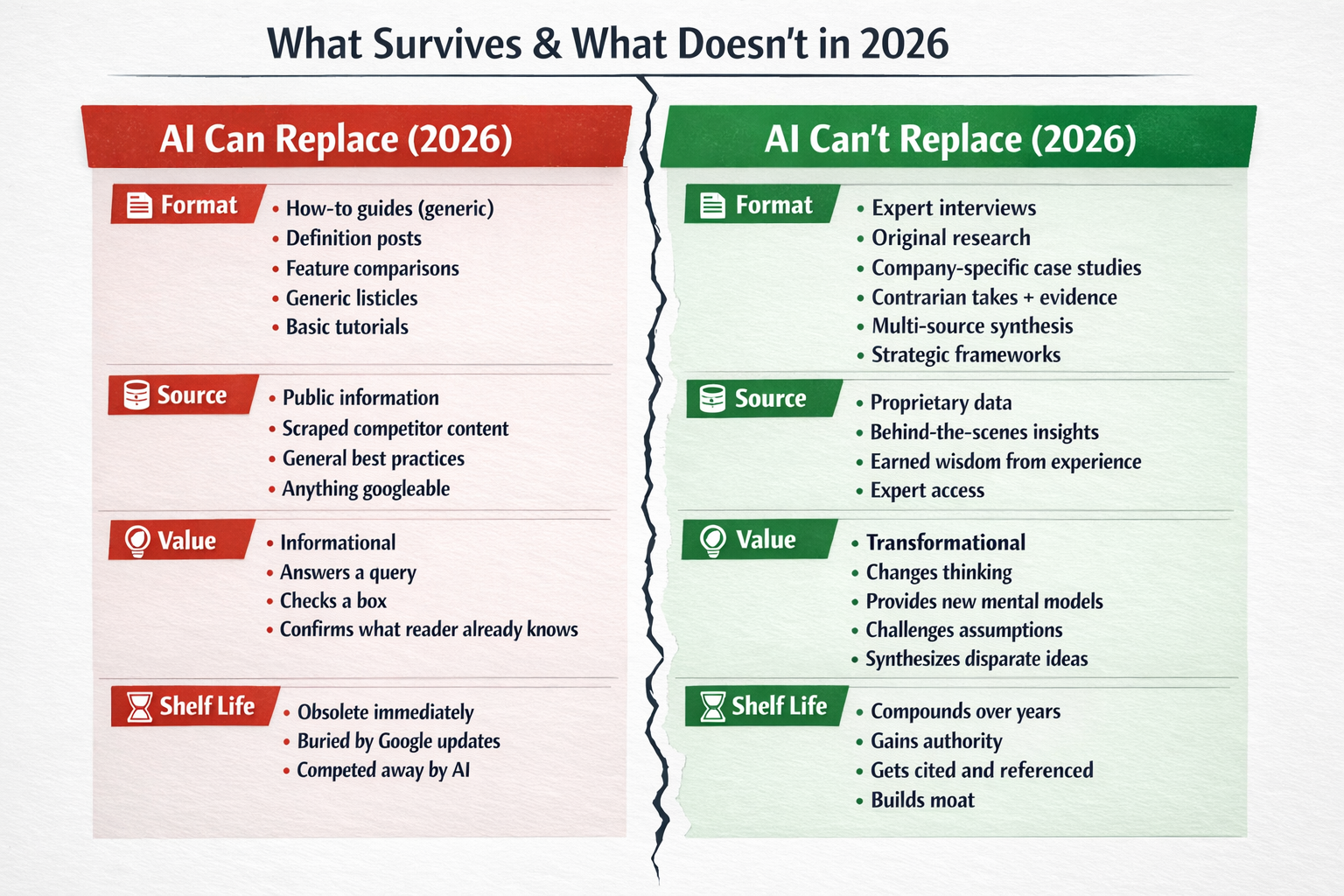
Notice the pattern? Everything AI can replace is commodity content. If ChatGPT can write it after being trained on three years of content, it's not worth writing.
Everything AI can't replace requires one thing: access. Access to experts who've done the thing over multiple years. Access to data that nobody else has. Access to experience and the mistakes you've made that others haven't. Access to synthesis and connecting dots AI can't see.
"But those posts ranked! They drove traffic! Some of them even converted!"
Yes. Past tense. They worked in 2020-2021 when the bar was on the floor and Google hadn't figured out how to penalize thin content at scale.
Here's what happened to that content:
2022-2023: Traffic started declining but most marketers blamed "market conditions" or "algorithm changes" (technically true, but missing the point)
2024: Major traffic drops. The Helpful Content Update and AI-specific algorithm changes started burying commodity content regardless of who wrote it
2025: Acceleration. Companies that bet on volume over quality saw 60-80% traffic declines year-over-year
2026: We're here. If your content could've been written by ChatGPT in 2023, Google already buried it. You just haven't checked your analytics recently.
So did AI kill good writing?
I think the real question is: Were we practicing good writing before AI?
Or were we just:
- Churning out templated content and calling it "strategy"
- Playing SEO keyword arbitrage
- Creating slightly-reworded versions of competitor posts
- Publishing "best practices" that everyone already knew
- Hitting content quotas (20 posts this month!) without asking if any of it mattered
Be honest. Looking at your blog from 2020-2023, how much was actually:
- Original thinking
- Novel insights
- Things that changed how people thought
versus:
- SEO theater
- Content created to hit a number
- Stuff you knew was mediocre but published anyway because "we need to post consistently"
What This Means
AI didn't take anything valuable from us. It just automated the bad stuff we were already outsourcing to $50 Fiverr writers and bored interns.
The writing that matters is the stuff that requires thinking, access, synthesis, and courage. That kind of writing is more valuable than ever. Because now there's less noise competing with it.
In the next article, I'll show you exactly how to create that kind of content. The tactical playbook: what to audit, how to build your expert network, how to develop frameworks AI can't steal, and the actual work that builds a moat.
But first, you need to accept that most of what we called "content marketing" from 2020-2023 wasn't worth defending.
The sooner you accept that, the sooner you can start building something that actually compounds.